Does Travel Protection Help Cover Terrorist Attacks? A Guide for Travelers in 2026

Key Takeaways
- Terrorism events may disrupt travel in ways that affect safety and the ability to continue or complete a trip.
- Our travel insurance and assistance plans offer specific terrorism‑related benefits, including Trip Cancellation, Trip Interruption, and Medical and Dental coverage when certain requirements are met.
- Terrorist events in Mexico and Australia highlight how terrorism‑related benefits apply differently based on the scale, timing, and impact of each incident.
Terrorism is, by its nature, unsettling and unpredictable, and often far from the mind when planning a vacation. Travelers focus on itineraries, destinations, and experiences, not emergency scenarios. Yet real‑world events continue to demonstrate that unexpected situations can unfold without warning, sometimes in places travelers visit every day.
Two recent situations made it clear how risky travel can be, with cartel‑related attacks in Mexico and a terrorist attack in Bondi Beach, Australia. Each event differed in severity, duration, and impact, but both serve as examples of how terrorism‑related benefits in travel protection may support travelers in moments when plans are impacted by acts of terror.
35% of respondents to our Summer Travel Survey reported that concern about terrorism is a major factor when planning a trip and traveling. With travel trends showing increased concern over global volatility, understanding how travel protection can help in these situations is an important part of trip planning.
This article focuses on terrorism‑related coverages that are part of our travel protection plans, and how those benefits function, and how the Mexico and Australia incidents illustrate their application. We recognize the profound sadness and real-world impact of these events on individuals and communities. Reader discretion is advised, as the content references acts of terrorism that some may find distressing.
Understanding Terrorism‑Related Coverage in Travel Protection
Our travel protection plans include several benefits that can be triggered by a covered terrorist act:
- Trip Cancellation
- Trip Interruption
- Medical and Dental
- Emergency Assistance and Transportation
- Accidental Death and Dismemberment-Travel Accident (Preferred and Premium plans)
We’ll dive into the details around each of these coverages in a moment, but it’s important to understand that coverage only applies when certain requirements are met. We define Terrorist Act as:
“An act of violence, other than civil disorder or riot, (that is not an act of war, declared or undeclared) that results in loss of life or major damage to property, by any person acting on behalf of or in connection with any organization which is generally recognized as having the intent to overthrow or influence the control of any government.”
Fear, uncertainty, or a desire to avoid a destination without a qualifying terrorist act occurring does not meet coverage criteria. This distinction helps clarify when benefits apply and why real‑world examples are useful in understanding plan details.
Because each benefit addresses a different aspect of travel disruption, the details of the event matter. Details of the event, location, timing, and the traveler’s trip schedule all influence whether a benefit applies.
When Trip Cancellation Coverage Applies
Trip Cancellation coverage is designed to reimburse prepaid and non-refundable trip expenses when a traveler must cancel a trip for a covered reason before departure.
To qualify for reimbursement, terrorism‑related cancellations must meet several conditions:
“A Terrorist Act which occurs in your Scheduled Trip Departure City or in a city to which you are scheduled to travel while on your Trip, and which occurs within 30 days of your Scheduled Departure Date, provided the city has not experienced a Terrorist Act in the past 30 days prior to the effective date of your coverage.”
The requirement that the terrorist act “occurs within 30 days of your Scheduled Departure Date” gives a specific timeframe that determines when a trip cancellation may be eligible.
Travel protection is intended for unexpected events and is generally not designed to cover situations that are already foreseeable. For this reason, plans often include provisions such as: “…provided the city has not experienced a Terrorist Act in the past 30 days prior to the effective date of your coverage.”
While these guidelines are necessary for determining eligibility, we recognize they relate to deeply serious and impactful events. They also underscore how both timing and location can influence coverage. The examples referenced are intended to help explain how factors like travel dates, destinations, and the recency or repetition of incidents may affect benefits, while acknowledging the real-world significance behind these circumstances. Additionally, if a traveling companion or family member at home is killed or seriously injured due to a covered terrorist act, you may also be covered under Trip Cancellation or Trip Interruption.
When Trip Interruption Coverage Applies
Trip Interruption coverage is similar to Trip Cancellation in that it’s designed to help you recoup non-refundable travel costs. While Trip Cancellation can help if you have to cancel your trip altogether, Trip Interruption can help if you’re on your trip but aren’t able to use all of your pre-paid arrangements.
In terrorism‑related scenarios, travelers already at a destination may qualify for reimbursement of the unused portion of their trip plus additional transportation expenses needed to return home or rejoin their travel party. Our Premium Plan offers up to 175% reimbursement of those covered trip costs, an extra buffer that can be very helpful if you need to reschedule flights and head home early due to a covered terrorist act.
For Trip Interruption, the same terrorism coverage requirements for Trip Cancellation coverage apply.
Emergency Medical Coverage and Assistance
If a traveler is injured during a terrorist attack while on their trip, Emergency Medical and Dental coverage is there to help provide reimbursement for medical treatment. This benefit supports travelers who experience physical harm during an attack and require immediate care at a destination.
In addition to the coverage itself, travelers also have access to 24/7 medical assistance services, which can be essential during high‑stress or fast‑moving situations. These services can help travelers:
- Locate appropriate medical facilities when they may not be familiar with local healthcare options
- Arrange medical transportation or coordinate transfers if specialized care is needed
- Communicate with medical staff through translation or interpretation support
- Navigate admission, treatment, and follow‑up care, especially when local procedures or requirements differ from those at home
Because emergency medical expenses can be costly and because medical environments during major incidents can be chaotic this combination of safeguards and real‑time assistance helps travelers access care and manage the complexities of receiving treatment abroad.

Accidental Death and Dismemberment
For Preferred and Premium plans, this benefit provides coverage if a traveler suffers a covered loss during a terrorist act. While not a benefit most travelers expect to use, it exists to provide financial support to designated beneficiaries in the event of a qualifying accident.
While rare, accidents happen. If you’re in an accident during your trip and suffer a loss of life, limb or sight, this coverage helps provide payment. In terrorism related situations, this means that if a traveler is involved in an attack and experiences a covered loss as a direct result, this benefit offers important financial support at a critical time.
Also Read: The Most Common Vacation Accidents
24/7 Travel Assistance Services
Travelers can rely on us for 24/7 Travel Assistance Services for support during unexpected events. These services are available anytime during your trip and can be especially valuable during rapidly changing or uncertain situations, including terrorism related incidents.
Travel Assistance Services can help with a wide range of needs, such as:
- Locating appropriate medical facilities and helping coordinate care
- Arranging medical transportation, including help navigating hospital transfers when needed
- Providing translation and interpretation support when speaking with medical staff, police, or local authorities
- Coordinating alternative travel plans, such as rerouting flights or assisting with replacement travel documents
- Emergency Message Relay, allowing travelers to send urgent messages to family, friends, or business contacts when direct communication is difficult
- Assistance with lost or stolen passports, including guidance on replacement steps and documentation requirements
- Connecting travelers with U.S. Embassy or Consulate services, including help finding consular offices, understanding available support, or obtaining information needed for emergency travel documentation
These services function as an immediate support network when travelers are dealing with unfamiliar systems, disrupted plans, or urgent communication needs. Assistance services are available to help travelers navigate challenges and regain stability during a difficult situation.
Examples of Events Considered Terrorist Acts
Mexico: Cartel‑Related Violence
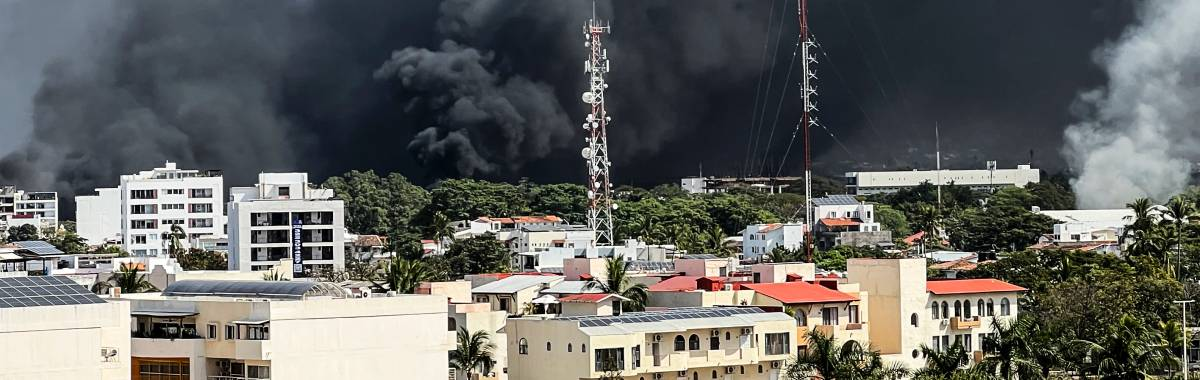
In February 2026, cartel related attacks in the Mexican state of Jalisco led to major and extended travel disruptions. Unlike shorter, contained events, this situation unfolded across multiple cities, involved sustained violence, and resulted in days of uncertainty for residents and visitors. We acknowledge the seriousness of this event and its impact on individuals, families, and the surrounding community. This example is included to help explain how more localized incidents may affect travelers and coverage considerations.
According to the U.S. Embassy, Puerto Vallarta residents and tourists were instructed to shelter in place while violent cartel activity and clashes with security forces spread across the region. Local authorities closed schools, redirected transportation, and deployed military support as part of the response.
Our position statement for the Cartel Attacks in Mexico described the event as involving widespread safety impacts across a large region. Travelers in or near impacted zones experienced an extended period of uncertainty, restricted movement, and instructions intended to protect public safety:
“Locals and tourists in Mexico are describing scenes of fear and uncertainty after a surge of violence erupted Sunday, February 22, 2026. The unrest began after Mexican authorities carried out a major operation against the Jalisco New Generation Cartel, reportedly killing its leader, Nemesio Oseguera Cervantes, known as “El Mencho,” during a raid earlier in the weekend. In the aftermath, cartel-linked groups set vehicles on fire, erected roadblocks, and attacked key routes in and around Puerto Vallarta and other parts of Jalisco in an apparent show of force and an attempt to disrupt security operations. As the violence spread, the U.S. Department of State and other foreign missions issued shelter-in-place alerts for Puerto Vallarta and surrounding areas, advising residents and tourists to remain indoors and limit travel. Transportation services, including some ride-shares and flights, were suspended due to blocked roads and safety concerns, and many businesses temporarily closed while authorities worked to restore order.”
The Mexico situation serves as an example of how wide‑scale violent activity across a region can affect traveler mobility and confidence. Even for travelers not directly in immediate danger, the combination of shelter-in-place guidance, transportation disruptions, and ongoing security operations made normal travel difficult or impractical. The multi-day duration and broad geographic impact illustrate how terrorism-related coverage considerations may arise during complex or extended events.
Australia: Terrorist Attack at Bondi Beach
We acknowledge the seriousness of this event and its impact on individuals, families, and the surrounding community. This example is included to help explain how more localized incidents may affect travelers and coverage considerations. In December 2025, a terrorist attack occurred at Bondi Beach during a crowded community event, resulting in significant immediate harm and an intense emergency response. Unlike the multi‑day, region‑wide disruption seen in Mexico, this incident was highly concentrated in one location and brought under control relatively quickly by authorities.
Our position statement for the incident explains:
“Officials said 15 people were killed after gunmen opened fire on attendees at a Jewish community event on Sunday, December 14, 2025, at Bondi Beach in Australia. At least 40 others were injured and hospitalized, including a child and two police officers. Authorities identified two suspects—a father and son—according to New South Wales Police Commissioner Mal Lanyon. Australian officials and international leaders have condemned the shooting as an antisemitic terrorist attack. The violence occurred during a Jewish holiday gathering marking the first day of Hanukkah, with more than 1,000 people present on the beach in a Sydney suburb when the shots were fired. Shortly afterward, responding officers located a vehicle along Campbell Parade that they believed contained several improvised explosive devices. Police said the vehicle was linked to the deceased gunman, and a bomb disposal unit was dispatched to the scene.”
This difference highlights an important point: The severity and geographic reach of a terrorist incident influence how travel protection benefits may apply. Localized incidents may affect fewer travelers and may have a narrower impact on itineraries, while broader events have wider implications for both arriving and in‑destination travelers.
Also Read: Travel Protection for Australia
Real Impacts to Travelers
While specific events may differ in scale, duration, or location, they often share common patterns in how they affect travelers — and in how travel protection can help. In many disruptive situations, travelers on the ground experience sudden changes, uncertainty, and difficulty accessing normal transportation or support services.
At the same time, those preparing to depart for an affected destination may face challenging decisions about whether to continue, modify, or postpone their plans. For travelers whose trips were directly affected, Trip Cancellation or Trip Interruption coverage may have helped reimburse prepaid and non-refundable trip costs when plan requirements were met.
Travelers injured during an attack could access emergency Medical and Dental coverage, and rely on 24/7 Travel Assistance Services for help locating medical care, coordinating alternative travel arrangements, replacing essential documents, or relaying messages to family and friends through Emergency Message Relay.
Events can vary widely in scope—some causing brief, localized confusion, others creating broader disruptions that affect transportation, public safety measures, and overall mobility for multiple days. Yet in all cases, travelers may face uncertainty, logistical challenges, and rapidly changing conditions.
Travel protection coverage and assistance services can help provide structured support across these scenarios, helping travelers navigate the aftermath, manage unexpected needs, and regain stability. These similarities underscore an important point: terrorism related benefits are designed to support travelers facing unpredictable and destabilizing events, whether the disruption lasts hours or days.

Why Terrorism Related Travel Protection Matters
The Mexico and Bondi Beach incidents demonstrate how unpredictable global travel can be—and how differently terrorist acts may impact trips. While most travelers will never encounter such events, having terrorism related benefits provides a safety net if a qualifying act affects their plans.
Travel protection helps address financial losses tied to covered unused bookings, unexpected transportation needs, and medical expenses, while assistance services offer real‑time guidance during difficult moments.
This is why it’s important to buy a plan early—events that happen before coverage begins aren’t eligible for benefits.
Get a fast and free quote today and explore travel protection options designed to support you and give peace of mind for your next trip.
Travel Resources
See All
10919002606

Average Customer Rating:

Thank you for visiting csatravelprotection.com