Americans Are Planning Summer 2026 Travel With Intention
Generali Global Assistance (“GGA”) today announced the U.S. findings from the 2026 Holiday Barometer (Europ Assistance + Ipsos) showing strong U.S. travel demand, higher budgets, and a rising focus on confidence and planning.
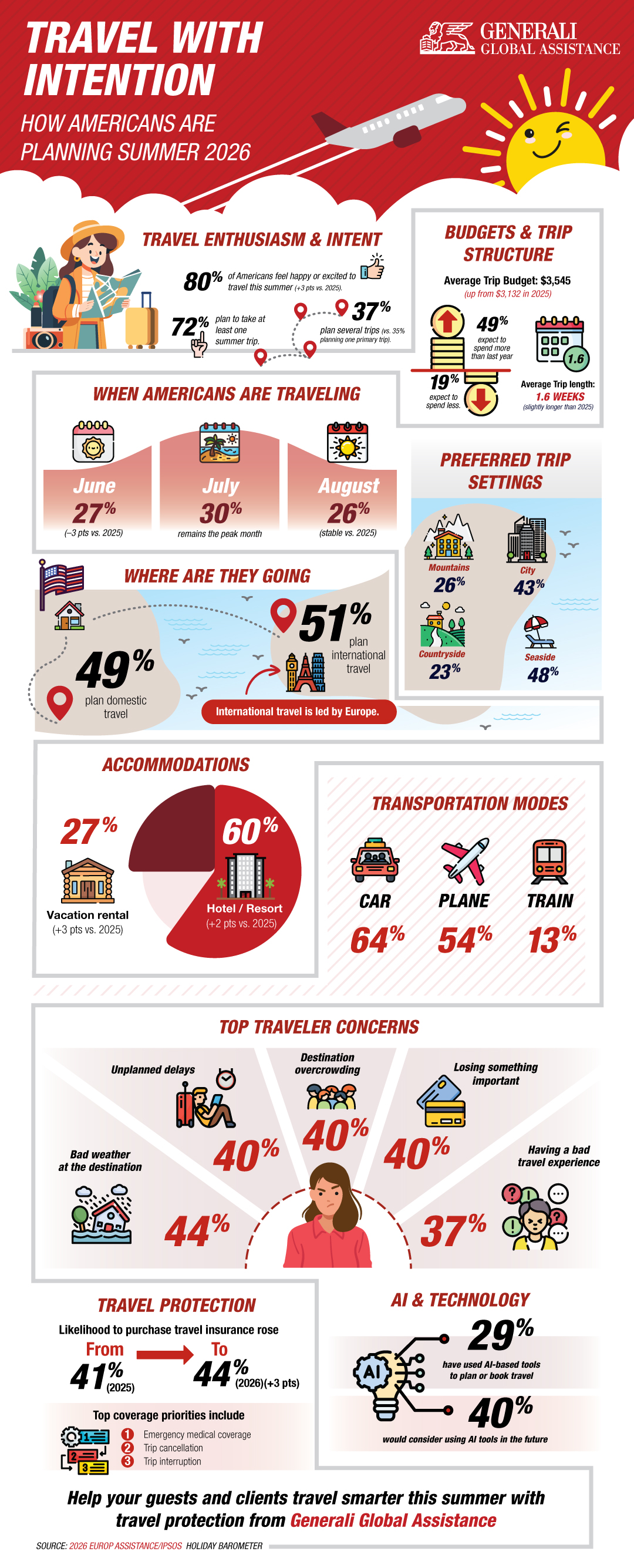
Summer travel enthusiasm remains high in 2026. According to the GGA 2026 Holiday Barometer, a global travel study conducted by Europ Assistance in partnership with Ipsos, 80% of Americans say they feel happy or excited to travel this summer up 3 percentage points compared to last year.
Nearly three-quarters of Americans (72%) plan to take at least one trip between June and September, and more than one-third (37%) expect to take several trips signaling a shift toward shorter, more flexible getaways rather than one single “main” vacation.
“American travelers are approaching summer 2026 with confidence, but also with intention,” said Paul-Adrien Maizener, CEO, Generali Global Assistance. “We’re seeing sustained demand for travel, paired with more thoughtful decisions around destinations, budgets, and protection. Travelers aren’t pulling back. They’re planning smarter and prioritizing peace of mind as part of the journey.”
Travel demand remains strong, while trip timing spreads across the season
July remains the peak month for summer travel (30%), while June (27%) and August (26%) remain close behind, suggesting demand is spread more evenly across the season.
Higher budgets, longer stays and familiar trip styles
The average U.S. trip budget is $3,545, with nearly half of travelers expecting to spend more than last summer. Average trip length is approximately 1.6 weeks, reflecting a slight increase year over year.
Travel plans are nearly evenly split between domestic and international trips (49% domestic / 51% international). International travel is led by Europe as the most common destination region for U.S. travelers.
When it comes to trip style, seaside and city settings are most commonly cited (48% seaside; 43% city), followed by mountains and countryside.
How Americans travel: cars and planes lead; hotels remain #1
Transportation plans continue to center on both driving and flying: 64% expect to travel by car and 54% by plane.
Hotels and resorts remain the most common accommodation choice (60%), while more than a quarter of travelers plan to stay in a vacation rental (27%).
Top concerns highlight why planning matters
Even with high enthusiasm, travelers cite practical concerns while planning: bad weather at the destination (44%), unplanned delays (40%), overcrowding (40%), and losing something important (40%) are among the top concerns.
Protection becomes part of the plan
Likelihood to purchase travel protection increased year over year, rising from 41% in 2025 to 44% in 2026 (+3 percentage points).
Among coverage priorities, emergency medical coverage ranks highest, followed by trip cancellation, and trip interruption.
AI is emerging in travel planning
Technology continues to shape how Americans plan: 29% have used AI-based tools to plan or book travel, and roughly 40% would consider using AI tools in the future.
Global travel context
“Building on the record levels seen last year, the desire to travel remains strong and undiminished, despite tougher trade-offs and the cost of living remaining a top global concern. What is changing, however, is the travel landscape itself. Security considerations are weighing more heavily on destination choices, with decisions increasingly shaped by risk considerations. At the same time, artificial intelligence is now a genuine planning tool for a growing share of travelers worldwide, demonstrating rapid momentum, particularly in emerging and high growth markets” says Virginie Babinet, CEO Travel Insurance & Assistance at Europ Assistance.
Globally, travel intentions remain high and stable following record levels last year, even as security considerations increasingly influence destination choices.
- Up to 8 in 10 respondents worldwide say they are enthusiastic about traveling this year.
- Security has become a leading destination-choice criterion in North America (32%) and North Asia (37%).
- AI adoption for trip planning continues to rise across markets; levels remain lower in Europe and North America than in several high-growth markets.
About the Study
The Holiday Barometer 2026 is based on the 2026 Holiday Barometer, a global travel study conducted by Europ Assistance in partnership with Ipsos.
The survey was conducted online between February 27 and April 7, 2026, among a nationally representative sample of 1,000 U.S. adults aged 18 and older.
In total, the 2026 Holiday Barometer covered 26 countries worldwide, including:
Germany, Austria, Belgium, Spain, France, Italy, Poland, Portugal, Czech Republic, United Kingdom, Switzerland, United States, Canada, Mexico, Brazil, Argentina, Japan, South Korea, Hong Kong, Malaysia, Singapore, India, Australia, New Zealand, Saudi Arabia, and the United Arab Emirates.
In each country, samples were built using quota methods based on gender, age, and profession, following stratification by region and city size, to ensure representativeness of the adult population.
About Generali Global Assistance
Generali Global Assistance (GGA) is a leading provider of travel insurance and assistance services. GGA is part of the Generali/Europ Assistance Group, which for over 190 years has provided peace of mind to its clients and their customers and is now supported by more than 72,000 employees worldwide. Our success is built on establishing trust by putting the customer at the core of everything we do, bringing them “From distress to relief. Anytime, anywhere.”
To learn more, please visit: https://us.generaliglobalassistance.com/
Media Contact
M Group Strategic Communications (for Generali Global Assistance North America)
Generalipr@mgroupsc.com
generalitravelinsurance.com/press
Facebook
Instagram
9278502505