
How Summer 2026 Travel Trends Are Shaping Demand for Vacation Rentals
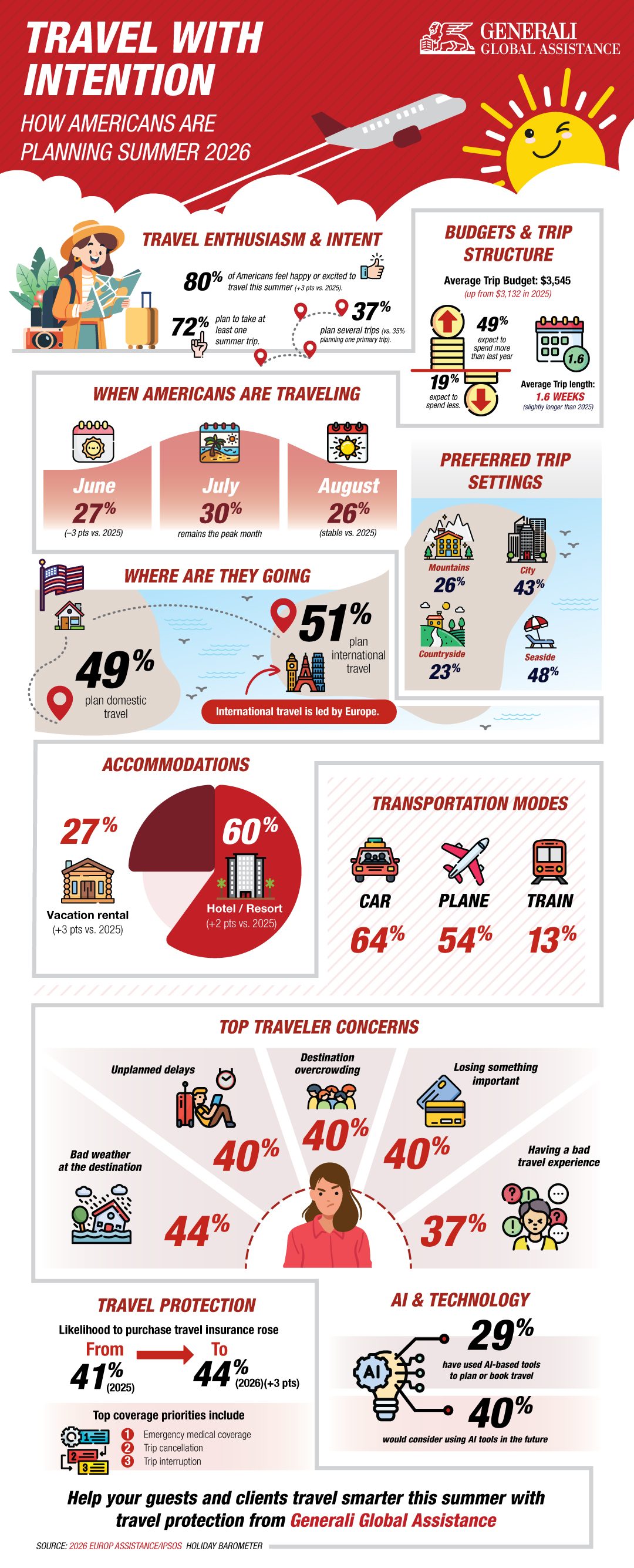
Summer travel demand is strong in 2026 — and travelers are approaching trips with intention. In our 2026 Holiday Barometer, 80% of Americans say they feel happy or excited to travel this summer, and 72% plan to take at least one trip between June and September.
For property managers, the headline isn’t just volume — it’s how travel is taking shape. More than one-third of travelers (37%) plan several trips, which can translate into more booking opportunities spread across the season.
Trips are spread across the season — and often closer to home
July remains the peak travel month (30%), but June (27%) and August (26%) are close behind, suggesting demand is distributed rather than concentrated in a single window.
Travel is also split nearly evenly between domestic and international (49% / 51%). For many property managers, that domestic demand can be a tailwind for drive-to and regional markets.
What guests want: seaside and city getaways lead the list
When asked what type of setting they intend to visit, travelers most often cite the seaside (48%) and cities (43%), followed by mountains (26%) and countryside (23%).
For property managers, this reinforces the importance of clear merchandising: proximity to beaches or walkable urban amenities, plus practical details that reduce friction (parking, check-in clarity, local guidance).
Transportation signals continued strength for drive-to travel
Two-thirds of travelers (64%) expect to travel by car, while 54% will fly.
Car-heavy travel tends to favor vacation rentals that support convenience: flexible arrival times, easy access, family-friendly space, and amenities that make “unpacking once” feel worthwhile.
Accommodations: hotels lead, but vacation rentals remain a meaningful share
While hotels and resorts remain the most common accommodation choice (60%), 27% of American travelers say they intend to stay in a vacation rental.
That 27% is a reminder that guests are choosing rentals for clear reasons: space, flexibility, and the ability to travel in a more “home-like” way.
Concerns are practical — and trust is the differentiator
Top traveler concerns include bad weather at destination (44%), unplanned delays (40%), overcrowding (40%), and losing something important (40%).
Property managers can’t control weather or airline operations — but you can reduce uncertainty in the stay itself. Proactive communication, transparent policies, and on-the-ground support help guests feel confident from booking to checkout.
Travel protection is becoming part of the planning process
Likelihood to purchase travel insurance increased from 41% last year to 44% this year (+3 pts).
For vacation rentals, that often reflects a broader mindset: guests want fewer surprises and more backup plans. Aligning your guest communications with that mindset alongside offering travel protection can help reduce friction and build loyalty.
AI is starting to shape trip planning
Nearly three in ten travelers (29%) have used AI-based tools to plan or book travel, and about 40% would consider using AI in the future.
This is a reminder that guests may arrive with research in hand — and they still value clear, trustworthy information from the host or manager.
About the Study
The Holiday Barometer 2026 is based on the 2026 Holiday Barometer, a global travel study conducted by Europ Assistance in partnership with Ipsos.
The survey was conducted online between February 27 and April 7, 2026, among a nationally representative sample of 1,000 U.S. adults aged 18 and older.
In total, the 2026 Holiday Barometer covered 26 countries worldwide, including:
Germany, Austria, Belgium, Spain, France, Italy, Poland, Portugal, Czech Republic, United Kingdom, Switzerland, United States, Canada, Mexico, Brazil, Argentina, Japan, South Korea, Hong Kong, Malaysia, Singapore, India, Australia, New Zealand, Saudi Arabia, and the United Arab Emirates.
In each country, samples were built using quota methods based on gender, age, and profession, following stratification by region and city size, to ensure representativeness of the adult population.