
More Trips, Smarter Planning: What Summer 2026 Travel Trends Mean for Travel Advisors
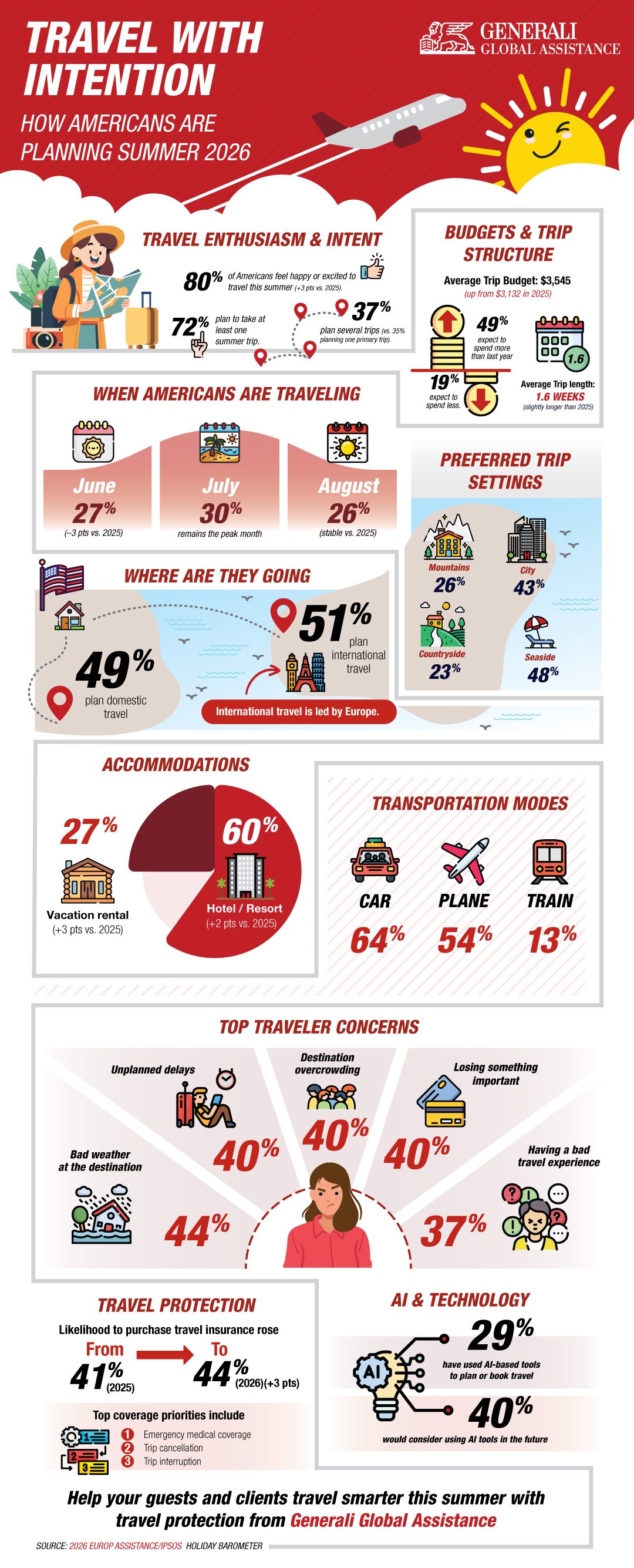
Americans are heading into summer 2026 with optimism — and intention. In our 2026 Holiday Barometer, 80% of travelers say they feel happy or excited about traveling, and 72% plan to take at least one trip between June and September.
At the same time, travelers are navigating higher costs and practical concerns. This creates an opportunity for advisors to guide decisions, set expectations, and help clients protect the value of their trips.
A summer of multiple trips, not one “main” vacation
More than one-third of travelers (37%) are planning several trips, signaling a shift toward flexible, multi-getaway summers.
Peak travel remains in July (30%), with June (27%) and August (26%) close behind — suggesting many clients will plan more than one window to travel.
Budgets are up — and so is the need to plan for disruption
The average summer trip budget is $3,545, and 49% expect to spend more than last year. Average trip length is ~1.6 weeks.
With higher trip values, the cost of disruption rises. That’s why advisors can add real value by proactively discussing contingencies and coverage priorities early in the planning cycle.
What clients are choosing: domestic vs. international, trip settings, and how they’ll travel
Travel plans are nearly evenly split between domestic and international (49% / 51%), with Europe leading international travel among U.S. travelers.
Trip settings reflect a blend of relaxation and exploration: seaside (48%) and city trips (43%) lead.
On transportation, clients are split between driving and flying: 64% plan to travel by car and 54% by plane.
Top traveler concerns advisors can plan around
Top concerns include bad weather at the destination (44%), unplanned delays (40%), overcrowding (40%), and losing something important (40%).
These are practical issues — and they align directly with the guidance advisors provide, from building realistic itineraries to adding buffer time, planning alternate routes, choosing the right suppliers, and ensuring documentation is in order.
Travel protection interest is rising — and coverage priorities are clear
Likelihood to purchase travel insurance increased from 41% in 2025 to 44% in 2026 (+3 pts).
Among protection priorities, emergency medical coverage ranks highest, followed by trip cancellation and trip interruption — reinforcing that clients are thinking about both health events and trip disruption. This presents a clear opportunity for travel advisors to introduce travel protection options and help clients plan with peace of mind.
AI is becoming a planning tool — advisors remain the confidence layer
29% of travelers have used AI-based tools to plan or book travel, and about 40% would consider using AI in the future.
Advisors can differentiate by validating options, adding context and supplier insight, and ensuring trips are designed for resilience—not just inspiration.
About the Study
The Holiday Barometer 2026 is based on the 2026 Holiday Barometer, a global travel study conducted by Europ Assistance in partnership with Ipsos.
The survey was conducted online between February 27 and April 7, 2026, among a nationally representative sample of 1,000 U.S. adults aged 18 and older.
In total, the 2026 Holiday Barometer covered 26 countries worldwide, including:
Germany, Austria, Belgium, Spain, France, Italy, Poland, Portugal, Czech Republic, United Kingdom, Switzerland, United States, Canada, Mexico, Brazil, Argentina, Japan, South Korea, Hong Kong, Malaysia, Singapore, India, Australia, New Zealand, Saudi Arabia, and the United Arab Emirates.
In each country, samples were built using quota methods based on gender, age, and profession, following stratification by region and city size, to ensure representativeness of the adult population.